

North Karelia Strategy 2045
North Karelia Strategy 2045 – Building a Resilient and Competitive Future
North Karelia is preparing for the future with ambition, resilience, and a strong sense of regional identity. The North Karelia Strategy 2045 sets out a long-term vision for sustainable growth, competitiveness, wellbeing, and security in a rapidly changing world. The strategy responds to major global shifts including climate change, demographic transformation, digitalisation, and geopolitical instability while building on the region’s unique strengths: its clean nature, strong industrial expertise, vibrant communities, and culture of cooperation.
At the heart of the strategy is the goal of strengthening North Karelia’s vitality and capacity for renewal. The region aims to create a future where economic growth, environmental sustainability, social wellbeing, and security reinforce one another. This requires bold decisions, long-term cooperation, and the ability to adapt proactively to change.
North Karelia’s economic competitiveness will be strengthened by supporting business-driven growth, investments, innovation, and internationalisation. The region already has a diverse economic structure, with strong expertise in technology industries, forestry, bioeconomy, and manufacturing. Future growth will increasingly depend on higher added value production, digital transformation, research and innovation activities, and the ability to attract both domestic and international investments. The strategy also highlights the importance of supporting entrepreneurship, ownership transitions in family businesses, and the development of future skills through high-quality education and lifelong learning.
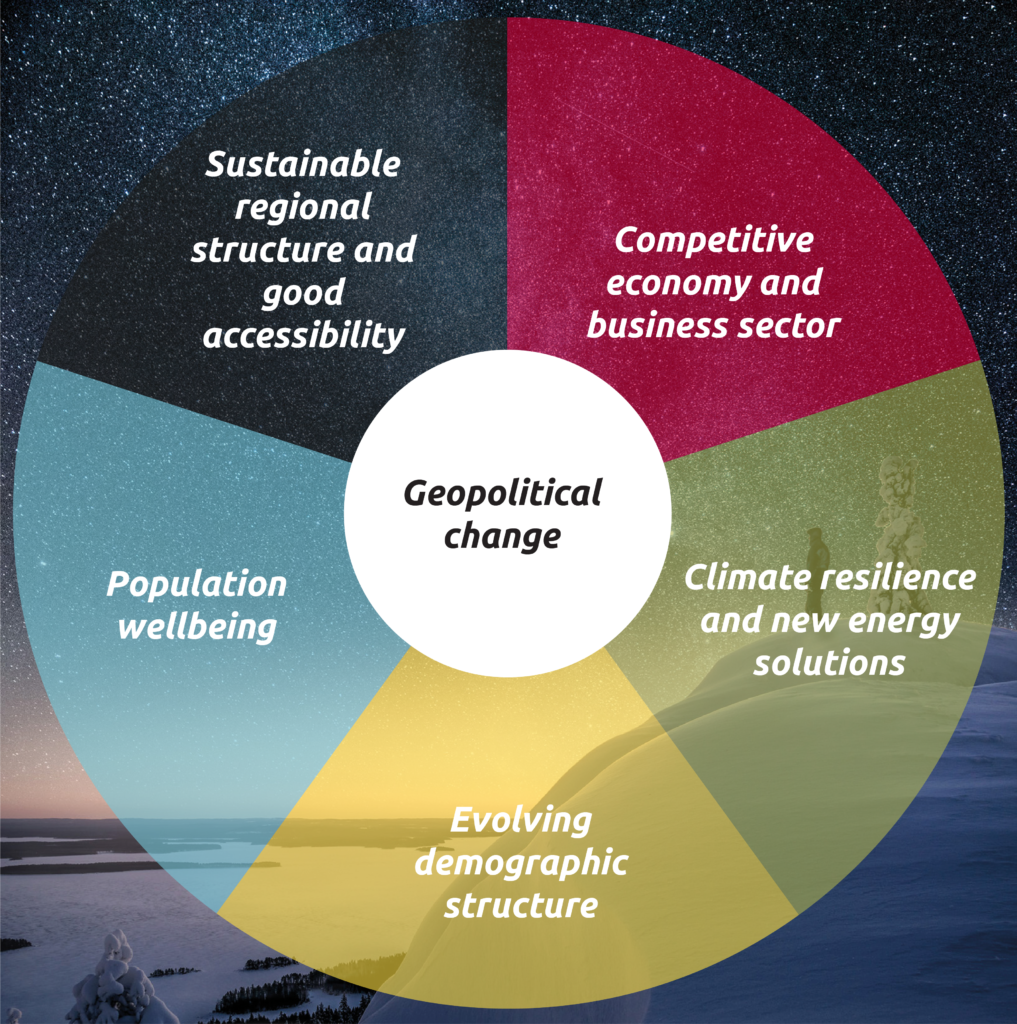
Climate resilience and renewable energy solutions form another cornerstone of the strategy. North Karelia aims to become a leading region in clean energy, circular economy solutions, and sustainable use of natural resources. The region already has one of Finland’s highest shares of renewable energy production, particularly through bioenergy, and significant potential exists for industrial-scale solar, wind, hydrogen, and energy storage solutions. At the same time, adaptation to climate change is recognised as equally important as mitigation. Sustainable forestry, clean water resources, biodiversity, and resilient food systems are seen not only as environmental priorities but also as future competitive advantages.
Demographic change is one of the region’s greatest long-term challenges. An ageing population, declining birth rates, and labour shortages require new solutions to ensure vitality and service capacity. The strategy emphasises the importance of attracting skilled workers, increasing work-based immigration, improving retention of students and young professionals, and supporting continuous learning. Technological development, automation, and digitalisation are also expected to improve productivity and help respond to workforce shortages. At the same time, public services must evolve to better meet future needs, with greater emphasis placed on preventive services and wellbeing promotion.
Wellbeing, inclusion, and community resilience are central to the future of North Karelia. The strategy promotes a society where all residents have opportunities to participate, access services, and live safely regardless of age, background, or place of residence. Preventing loneliness, social exclusion, and regional inequality is considered essential for maintaining social cohesion and trust. Strong cooperation between municipalities, the wellbeing services county, educational institutions, businesses, and civil society organisations plays a key role in strengthening resilience and quality of life across the region.
Accessibility and balanced regional development are also critical priorities. North Karelia seeks to maintain a functional and attractive regional structure where Joensuu serves as the regional centre while smaller towns and rural communities remain vibrant and connected. Efficient transport links, digital infrastructure, and support for multi-local living are essential for future competitiveness. Key development goals include improving railway connections, securing air traffic accessibility, strengthening road networks, and expanding high-speed digital connectivity throughout the region.
The changing geopolitical situation has significantly reshaped North Karelia’s position as a border region. Russia’s war against Ukraine and the closure of eastern border traffic have transformed the regional operating environment. In response, the strategy emphasises comprehensive security, crisis preparedness, cybersecurity, and societal resilience. At the same time, the region aims to turn challenges into opportunities by strengthening self-sufficiency, renewable energy production, logistical resilience, and cooperation within Finland and Europe.
North Karelia Strategy 2045 is ultimately a vision of a region that combines sustainability, security, innovation, and wellbeing. It is a roadmap for building a resilient future in which people, businesses, and communities can thrive even in uncertain times. With its strong natural assets, expertise, and collaborative spirit, North Karelia has the potential not only to adapt to global change, but to lead through it.